

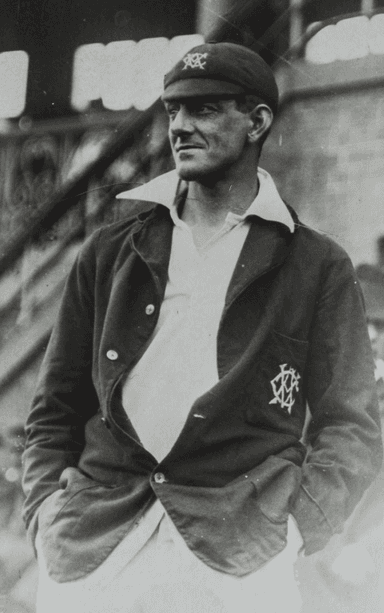
Club Legend · inducted 2024
Edgar Arthur ‘Ted’ McDonald was born in Launceston, Tasmania in 1891. He played cricket for Tasmania in 1909-10 and 1910-11 before moving to Victoria and joining Fitzroy Cricket Club. He made the Victorian team for the first time in 1912. By 1919 he was taking wickets regularly and was selected for the Australian Test Team (cap no. 114) for 3 Tests against England in 1920-21. He took only 6 wickets in these Tests but was selected for the 1921 Tour of England where he was the outstanding Australian bowler on the Tour. On the Tour he took 150 wickets, including 27 in the Test matches. His 1921 season resulted in him being named one of Wisden’s 5 cricketers of the year in 1922. His partnership with Jack Gregory is often described as the first great fast bowling combination in Test Cricket history. He played 3 more Test matches in South Africa before accepting a role as a professional in the Lancashire League for Nelson CC, thus ending his Test career for Australia, and making him the highest paid cricketer in the world at the time.
He duly qualified to play County Cricket for Lancashire where he was highly successful. He took 1053 wickets for Lancashire from 1924-31, placing him eighth on the County’s all-time list, and also made a first class century against Middlesex at Old Trafford in 1926. During his time at Lancashire, they won the County Championship 4 times, the most successful period in their history. In those 4 championship years he took 588 wickets.
In 1930, playing for Lancashire against the touring Australians, he bowled Don Bradman, beating him for pace. In his book “Farewell To Cricket”, published in 1950, Bradman says of this match “My first meeting with the great Australian fast bowler, Ted McDonald, who was then playing for Lancashire, was brief. My middle stump went flying, and I am ready now to argue his place amongst the greatest of all fast bowlers. It was hard to visualise a more beautiful action which, coupled with splendid control and real pace, made him the most feared bowler in England at that time, as he had been years before for Australia.”
Later in his book, Bradman comments on his era in cricket “I rate Lindwall and McDonald the two finest Australian fast bowlers of the period. McDonald had a higher delivery than Lindwall and marvellous stamina. Purely as a bowler there can be little between them.”
Later, when comparing fast bowlers, Bradman says “The tremendous success of the Gregory-McDonald combination always brings these two into the limelight together. Gregory was without doubt the greater player because of his superlative fielding and fine batting, but, purely as a bowler, McDonald was his superior. This tall lean Victorian had a perfect rhythmic action, incredible stamina and real pace plus the ability to do things with the ball. Taking everything into consideration he would probably win a Gallup Poll – take the points for the best of all fast bowlers.”
After finishing County Cricket with Lancashire (aged 40), McDonald went back to the Lancashire Leagues where he was pro for Bacup for a further two years.
English cricket writer Neville Cardus wrote of a match in which McDonald played, “Whence does McDonald draw his terrible strength and velocity? His run to the wicket is so easy, so silent. He does not thunder over the earth like Gregory – like a bull at a gate. No, he runs along a sinister curve, lithe as a panther, his whole body moving like visible, strange music. A more beautiful action than McDonald’s was never seen on a cricket field or a more inimical. The man’s whole being tells of the sinister, destructive forces of nature – he is a satanic bowler, menacing but princely. Yesterday he was at his best; he like a comet burned, and from his wheeling arm shot pestilence and war. His attack mingled in proportion the strength of the lion and the subtlety of the serpent… Bowling of McDonald’s skill and dreadful beautiful energy ennobles the game; the spark of it belongs to life immortal and it kindles imagination’s fires in all men who look on.”
A biography, “The Silk Express” by Nick Richardson, tells his life story.
For Australia, he played 11 Test matches (all in the calendar year of 1921), taking 43 wickets at 33.27 (best 5/32).He made 116 runs at 16.57.
In all first class cricket (for Tasmania, Victoria and Lancashire) he played 281 matches, and took 1395 wickets at 20.76 (best 8/41) with 5 wkts/innings 119 times and 10 wkts/match 31 times. He made 2661 runs at 10.43.
For Fitzroy, he played 89 games from 1912-13 until 1929-30 taking 360 wickets at 15.39 with a best of 9/47 and 5 wkts/innings 30 times and 10 wkts/match 3 times. He also made 1338 runs at 14.86 with one century.
He also played Australian Rules Football for Launceston, Essendon (2 games 1912) and Fitzroy (46 games 1913-1919).
McDonald died in England in 1937 when the car he was driving collided with another near Blackpool. He survived that crash but was killed by another car while discussing the first accident with the other driver and police.